
Work in an Office? Read This!
Many people say that working in an office is one of the most safe things that a person can choose for a career but new research is suggesting that there are a lot of aspects about working in an office that can really hurt your health. One of them, is the likelihood of bed bugs being in your office. You may think it’s impossible but even the nicest buildings have been known to be infested from time to time.
“YOUR SOFTWARE’S BUGS ARE NOTHING COMPARED WITH THE REAL-LIFE CRITTERS LURKING.”
Modern office workers have much bigger problems than a bad boss – or should we say smaller? From Google’s corporate offices to the bureaus of the Internal Revenue Service, even the most secure workplaces have fallen prey to increasingly brazen trespassers: bedbugs. A survey by the National Pest Management Association and the University of Kentucky found that 38% of extermination companies treated bedbugs in office buildings in 2011, compared with only 18% in 2010. The office environment is the ideal habitat for not only bedbugs but also roaches and other insects who thrive in the climate-controlled digs, feed on workers’ crumbs (or their flesh) and stretch their legs at night when all the humans go home (allowing them to survive longer undetected), says Orkin’s Baumann.Even bedbugs, which need human blood to survive and normally come out at night while their targets are sleeping, will alter their habits in offices and bite people during the daytime. The office safari doesn’t end there: Occupational safety consultants like Towles have seen a range of wildlife invade the workplace, including birds, rodents, small snakes and even venomous brown recluse spiders, lurking in office drawers and file storage areas. “That’s called a bad day,” Baumann says.
And employees have more than bug bites and diseases spread by pests to worry about – experts report seeing workers shunned by their colleagues after an infestation is found in their desk.Read more on how to prevent bed bugs at work here: http://bit.ly/1m5aC0m





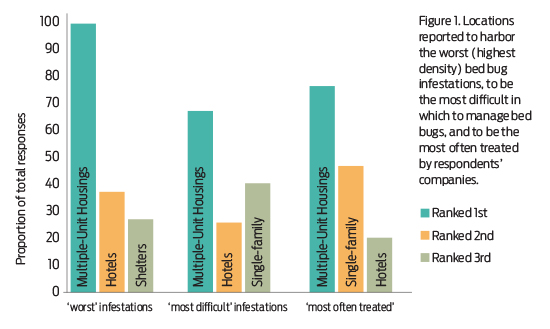
 Most respondents (73%) believed that bed bug infestations had increased in 2014 as compared to 2013 while some (22%) believed that the levels of infestation had not changed during this period. This trend was stable when considering responses from different regions and states, suggesting that bed bug incidence may be increasing throughout the nation. Virtually half (49%) of all respondents considered summer to be the season with the most calls for bed bug services, while another large proportion (44%) reported no differences between seasons. It is unclear whether summer incidence may be driven by increased human travel, increased ambient temperature, or some combination of these and perhaps unknown factors. Though resistance to insecticides within bed bug populations has been a concern for some time now, the majority (57%) of respondents in this survey did not believe they had encountered resistance in the field. This was true even when considering data only from the Midwest and the Eastern Seaboard, where resistance in field populations has been reported as widespread. Furthermore, though insecticide resistance may be more easily recognized by those with the most years working in the field, the level of experience of respondents had no effect on this reported belief. MUHs, the focus of this survey, were considered by most respondents to harbor the worst (highest density) bed bug infestations, to be the most difficult locations in which to manage bed bugs, and to be the locations most often treated by their companies (96%, 65%, 74%, respectively) (Figure 1, above). Hotels/motels and shelters were also believed to harbor high-density infestations.


